The Lifecycle of Energy
We are composed of compounds born in the hearts of dying stars. Every atom of carbon in your body, every silicon wafer in every chip, was forged in stellar nucleosynthesis billions of years ago. We are stardust — and to elevate ourselves, we must harness derivatives of stardust once more.
"It is humbling to consider that if we harness just one-millionth of the Sun's power for AI, that will be much more than a million times the intelligence of all of humanity."— Elon Musk
The physics underneath everything
Einstein's mass-energy equivalence is not an abstraction — it is the operating principle of every star. A single kilogram of matter, fully converted, yields 90 petajoules of energy. The Sun converts 4 million tonnes of mass into pure energy every second. This is the engine of civilisation.
Stellar nucleosynthesis
Stars are not merely sources of light. They are element factories. In stellar cores, hydrogen fuses into helium, helium into carbon, carbon into oxygen — cascading up the periodic table through billions of years of nuclear fusion. When a star collapses, the resulting supernova scatters these elements across space. The silicon in a solar panel. The copper in a cable. The rare earths in a battery. All forged this way.
"The cosmos is within us. We are made of star-stuff. We are a way for the universe to know itself."— Carl Sagan
II. The Catch
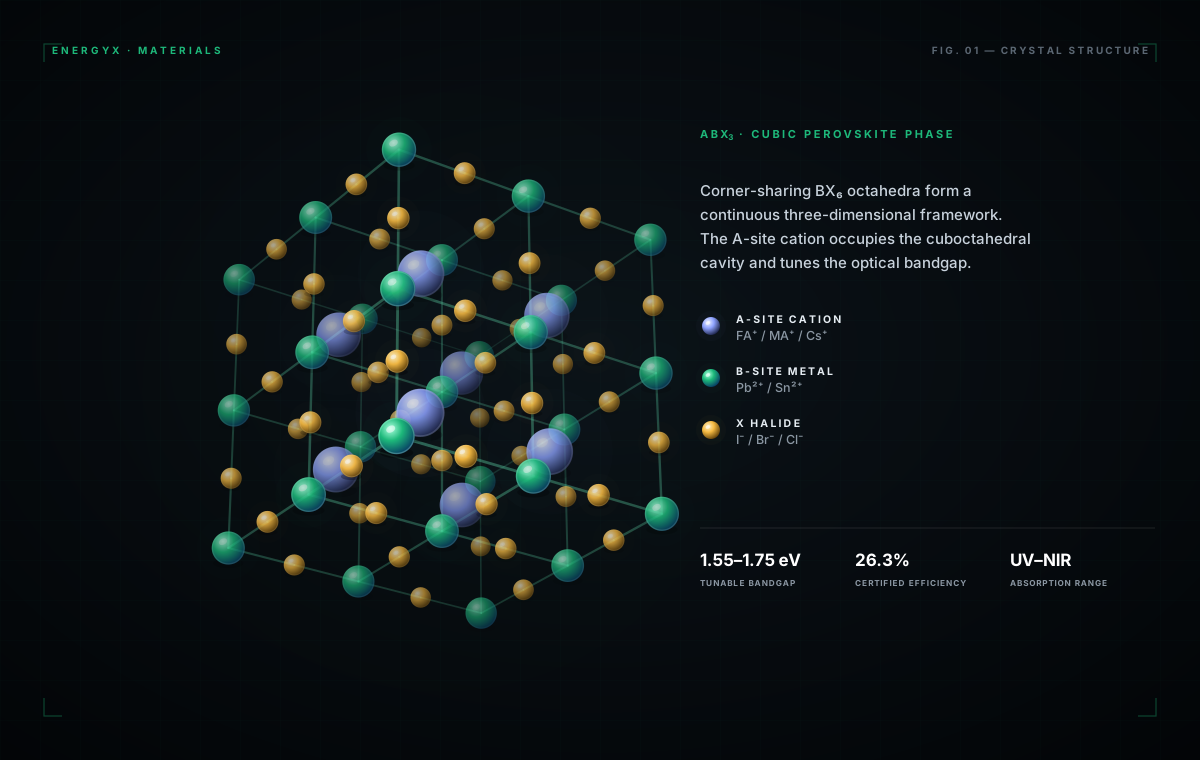
A single photon strikes an atom and frees a single electron. Revolutions don't begin with power plants — they begin with the smallest things we finally understand. Move your cursor through the lattice.
Material science
This is where EnergyX Foundry begins — the physical engine that turns these materials into building surfaces.
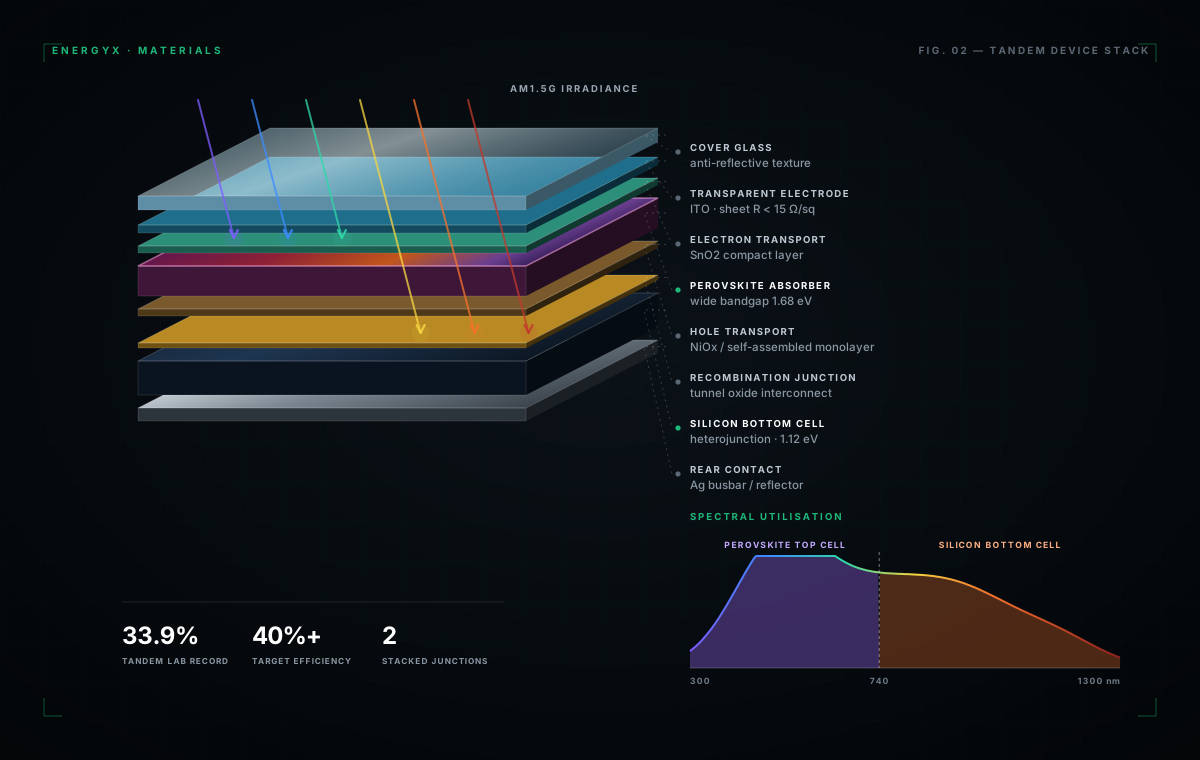
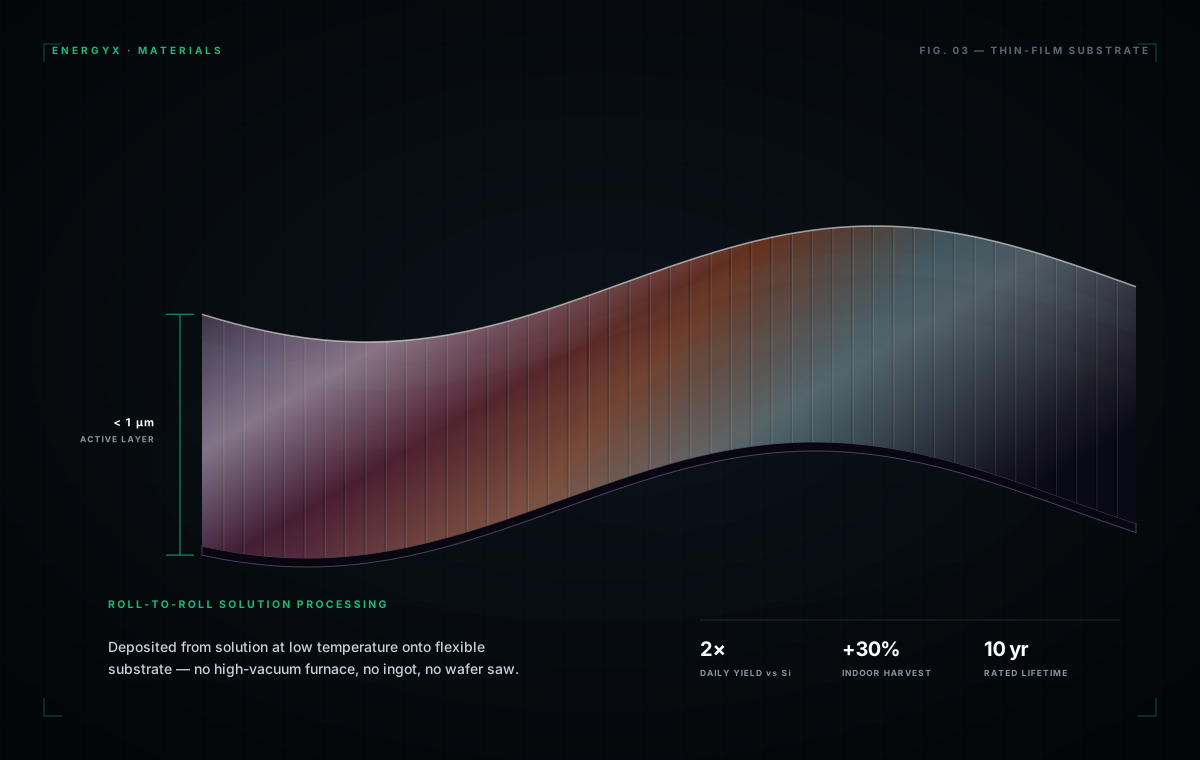
The photovoltaic effect — discovered by Edmond Becquerel in 1839 — converts sunlight into electrical current with no moving parts and no combustion. Perovskite-silicon tandem cells achieve far higher efficiency than traditional silicon alone. At scale, this is civilisation's most elegant energy technology.
But materials alone don't create energy systems. They need buildings, cities, and intelligence optimizing them.
III. The Harvest
Not a panel bolted onto the world — the skin of every structure turning sunlight into power. Buildings that generate more than they consume become nodes in a network.
Architecture
The building envelope is the largest underutilised energy asset in the built environment. EnergyX's DFMA panel system transforms every external surface — façade, roof, canopy — into an integrated power generation node.
Less reliance on remote generation and long transmission lines. Power generated at the point of consumption, embedded into the architecture itself.
Conventional photovoltaics impose a design tax. Panels arrive flat, rectangular and uniformly blue, and the building is asked to accommodate them. The DFMA process inverts that relationship: because every panel is parametrically defined and formed in the factory rather than selected from a fixed catalogue, the envelope can follow the architecture instead of constraining it — double-curvature façades, tapered and twisting profiles, non-orthogonal geometry, and specified colour, texture and transparency — with structural performance and yield engineered for each configuration.
The result is that solar stops being a compromise applied to a design and becomes part of the design language. A building no longer has to look like a solar project to be one.
IV. The Network
Distributed energy systems. Where EnergyX Intelligence is deployed, buildings share data and demand is balanced against generation. Thousands of surfaces, generating. A generating building draws less from the grid — and, project by project, some give back. The world stops asking where do we plug in — and starts asking what it can now afford to build.
V. The Wall
The largest wave in technology's history is running into a wall. Roadmaps are quietly contracting — models that should exist can't, because the power isn't there. The most ambitious thing we've attempted is throttled not by intelligence, but by the watts to feed it.
The constraint
The energy constraint on AI is real.
Every AI model trained. Every query answered. Every autonomous system running. Each consumes energy at a rate the existing grid cannot support.
Data centre electricity demand is projected to reach around 945 TWh by 2030 in the IEA's 2025 base case — close to Japan's entire annual consumption, added to the planet in six years. A single NVIDIA H100 GPU draws up to 700 watts; a training cluster of thousands draws tens of megawatts. The largest frontier training clusters now draw 300 megawatts — a scale that did not exist three years ago.
Power availability, not chip supply, is becoming the binding constraint on the AI build-out. A data centre is, structurally, a building — an enormous roof and façade wrapped around a very large load. It is the building-energy problem at its most concentrated. This is the problem EnergyX was built to solve.
VI. The Brick
Two proprietary technology engines in a closed loop. Intelligence evaluates design options and verifies them against engineering requirements. Foundry turns the selected decisions into energy-generating systems. Our commercial and operating base supports deployment, lifecycle services and performance feedback, helping both engines improve subsequent decisions.
Turns building surfaces into energy-generating infrastructure through advanced energy materials, including perovskite photovoltaics, architecturally integrated solar skins, and digital fabrication of complex forms. It translates engineering decisions into physical systems designed for the building, its performance requirements and its manufacturing constraints.
Combines multimodal AI, geospatial intelligence, engineering data, deterministic simulation and optimisation to evaluate and verify decisions across building design, energy performance, manufacturability, cost and lifecycle economics. It determines what should be built and how it should perform before those decisions become physical systems.
Deployment, commissioning, performance monitoring, predictive maintenance and grid-services participation run beneath both engines, across the operational life of every installation.
Where Big Tech hit a wall, EnergyX makes energy efficient at the source and eases the ceiling on the AI wave. AI can't wait for the grid. It needs generation at the source.
VII. The Frontier: Long-Horizon Vision
Where the Sun never sets, the final move is orbit: data centres bathed in unfiltered sunlight, radiating their heat to space. No land. No water. The constraint that defined the AI era loosens its grip. A long-horizon vision — not a current programme
VIII. Full Circle — Work With Us
And in doing so, we are building the energy infrastructure of the intelligence age. We've proven the model: 20,000+ buildings in our footprint, 2,000+ of them delivered with the integrated system, 300+ IP assets. We began with stardust. Now we refine it into materials. We build it into surfaces. We connect those surfaces into networks. We feed those networks with intelligence. And intelligence feeds on energy. EnergyX works with enterprises and AI operators managing power as mission-critical infrastructure.
If you operate buildings, campuses, or facilities at scale and energy is a material cost or risk — this is a conversation worth having.
"When something is important enough, you do it even if the odds are not in your favour."— Elon Musk
info@energyx.co.kr · Global HQ: Doha, Qatar
"We are ready to build. We ask our partners to build it with us." — ENERGYX